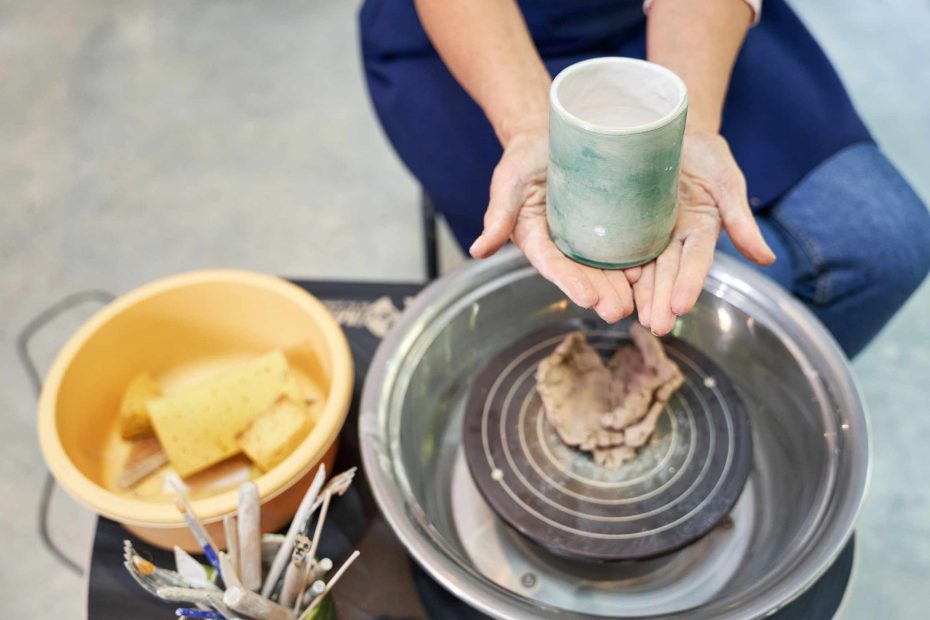
You don’t need a big first dish to learn, and in many ways, a smaller shape is more useful for feedback. A shallow dish, small tray, or simple pinch bowl allows you to focus on how the clay responds to hand pressure, the start of any rim stretching, and whether the piece’s base is even and flat. With less work needed to control the piece, you can focus on the details.
Often, a good option for a first dish shape is one that has a stable wide base, a moderate wall, and not a super-high rim. If the piece is a super-deep bowl, tall cup, or curved dish, you will need a greater understanding of controlling your wall thickness, the wetness level, or both. A low dish shape gives you more freedom to work the clay. You can press, smooth, rotate, and adjust the edge without constantly worrying about the walls slipping.
Before you start, consider the technique you want to practice. Slab shapes are good for rolling out an even thickness of clay, cutting a piece with a simple outline, or lifting the slab without stretching it as much as if you were pulling on the clay from the edges. Pinch shapes are good for checking the thickness with your fingers and seeing the areas where you press. If you want to try coil-built edges and score, slip, and compression, you may need a simpler shape first because of the extra steps added to the process.
The decoration you plan to use also needs to be considered. If you want to try out texture stamps or carving or sgraffito, the surface area of the clay dish may need to allow enough room for your marks to show. A small curved wall bowl may be cute, but it may be hard to stamp evenly without altering the shape. Small, flat, or shallow dishes allow you to test the texture, where your marks sit, or if you plan to use underglaze. They can also stay small enough for you to handle more easily.
Try making several small shapes, all starting from the same amount of clay. For example, you can make a slab tray, a shallow pinch dish, and a small, shallow dish with a small lifted rim. Don’t decorate the clay yet. Place them flat on a surface and check the base, the wall thickness, and the rim. See which piece is stable, which is wobbly, or where your fingers were pressing harder. This will help you see how different shapes perform. It’s easier to learn this way than trying to get a specific shape right.
Often, a new dish project may become too difficult because the first shape has too many extra things to do, like making a new shape, working with a thinner edge or rim, adding feet, carving, or choosing where to put underglaze, all at once. Try focusing on shape and keeping your surface simple, or if texture is the focus, keep the dish shape simple. If one thing is the focus, it’s easier to see what made a shape crack, wobble, or have uneven thickness.
The best first decorative dish has some room to pause and work the clay. You may check whether the clay is too soft to support the rim before you work the edge. You may be able to smooth the clay with a damp sponge and not have to soak it. You may be able to check and adjust the design when it starts to get more leather-hard. A first dish doesn’t have to be perfect, but you should be able to see the results of what you tried doing and what you can do to improve it next time. That is the better place to start than learning how to get a complicated shape right in frustration.